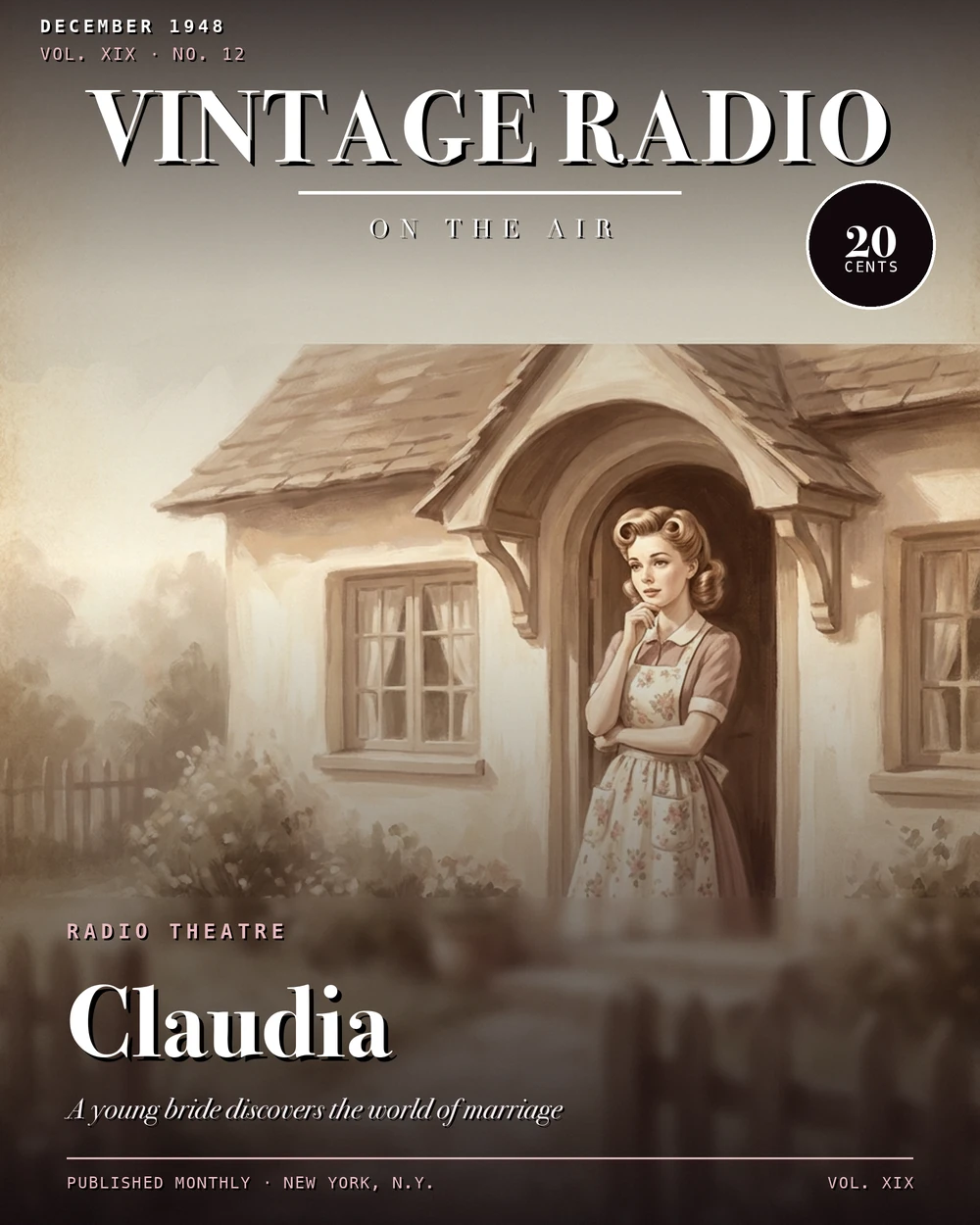
Claudia
A Character Who Grew Into a Franchise
Before the radio series launched in the summer of 1941, Claudia already had a life of her own. Rose Franken introduced the character — an impulsive, childlike young woman navigating the early days of marriage — in a run of ten short stories published in Redbook magazine between October 1938 and August 1939. Those stories, written with her husband William Brown Meloney, were collected in the 1939 book Claudia: The Story of a Marriage, and the character caught on in ways that surprised even her creator. A Life magazine piece from March 31, 1941, called Claudia "one of the oddest phenomena in the entertainment world" and marveled at how "a little idea like Claudia can grow into big business." By the time the radio series aired, that assessment was already looking modest.
The stage version arrived first. The Broadway play Claudia, written and directed by Franken and produced by John Golden, opened at the Booth Theater on February 12, 1941. It ran for 722 performances and closed in 1943. Golden later said it was his favorite of his more than 100 Broadway productions. Richard Watts of the New York Herald Tribune called it "the best new American play of the season by all odds." The lead role went to Dorothy McGuire — a relatively unknown actress whose main prior credit was understudying Emily in Our Town — chosen over Gertrude Lawrence, who wanted the part. It was a characteristic Franken decision: she understood who Claudia was, and she cast accordingly.
The radio series came right on the heels of the play's success. Claudia and her husband David began as 10-minute sketches on The Kate Smith Hour, with the June 6, 1941 broadcast marking their first appearance. When Kate Smith's program went on summer hiatus, those segments expanded into a full half-hour weekly drama. General Foods sponsored the show, advertising Grape Nuts and Grape Nuts Flakes, and the series aired on CBS every Friday at 8 from July 4 through September 26, 1941.
The Show Itself
Patricia Ryan played Claudia — eighteen at the time of her marriage to David Naughton, an architect played by Richard Kollmar. The two had married at City Hall, dramatized in the second regular episode on July 11, and the series followed their efforts to build a life together on limited means. The "everyday drama" Franken favored ran to counting pennies, balancing checkbooks, and fixing things around the house. These were not large conflicts. The show found its tension in small domestic pressures and the particular difficulty of a young woman trying to grow up while still half-attached to her mother. Much of the series' conflict turned on the possessiveness of Claudia's mother, Mrs. Brown, played by Jane Seymour. David's mother, Mrs. Naughton, was played by Irene Hubbard. Charles Stark announced, and Peter Van Steeden provided the music.
Van Steeden, born in Amsterdam in 1904, was best known as the composer of "Home (When Shadows Fall)" — a song Nat King Cole, Louis Armstrong, Ella Fitzgerald, and Ethel Merman all recorded. Before Claudia he had led the orchestra on Fred Allen's Town Hall Tonight, taking over from Lennie Hayton in April 1935. Kollmar had already put in substantial radio and stage work before the series. He appeared on Broadway in Knickerbocker Holiday in 1938 and Too Many Girls in 1939 — the latter alongside Desi Arnaz — and had played Dennis Pierce in the CBS soap opera Pretty Kitty Kelly from 1937 to 1940. The New York Times once described him as "an exuberant comedian unspoiled by cleverness." He would go on to play the title role in the syndicated series Boston Blackie and, beginning in April 1945, co-host the morning radio program Breakfast with Dorothy and Dick on WOR with his wife, journalist Dorothy Kilgallen, eventually drawing an audience of up to 20 million listeners.
A 1949 Radio Album article noted that "people who should know claim that Miss Franken is Claudia" — a comment that points at how personally the author invested in the character. Franken herself, writing in her 1963 autobiography When All Is Said and Done, acknowledged that "the sheer technical task of remaining within her consciousness became increasingly onerous and demanding" over her two decades with Claudia. That's an honest account of what it costs to sustain a single character across novels, plays, films, and broadcasts for so long.
Films and a Second Life in Syndication
The 1943 20th Century Fox film Claudia brought the character to the widest audience yet. Directed by Edmund Goulding and written by Morrie Ryskind, it starred Dorothy McGuire — reprising the role that made her name on Broadway — alongside Robert Young and Ina Claire, with cinematography by Leon Shamroy and a score by Alfred Newman. It was McGuire's film debut. Young later recalled that the film "did sensational business" and that Fox immediately wanted a sequel. McGuire declined at first but was overruled by her contract with producer David Selznick. The sequel, Claudia and David, appeared in 1946, directed by Walter Lang, with Young and Mary Astor joining McGuire again.
The film success prompted Coca-Cola to sponsor a new radio incarnation. The 1947–1948 syndicated series was a 15-minute weekday program — a different format from the 30-minute Friday night broadcast of 1941 — distributed via electrical transcription. Katharine Bard and Paul Crabtree played Claudia and David. Peggy Allenby took the role of Mrs. Brown, replacing Jane Seymour. Joe King announced. The run was substantial: surviving episode numbers reach well into the 390s, indicating more than a year of daily broadcasts. Titles from that period give a feel for the show's texture — "Lotte from the Bronx Recognizes the Farmer's Wife Within Claudia," "A Visit to Coney Island," "The Country Auction." The same domestic grain, the same tight orbit around the couple's ordinary life.
What Followed
The character kept moving after radio. The novel series grew to eight books, selling well across the United States and in twenty countries abroad. An omnibus edition, The Complete Book of Claudia, appeared in 1958. The arc of those books took Claudia and David through the birth of two sons, serious illness, the war, financial strain, and the death of Claudia's mother — the full weight of a life, not just the bright uncertainty of early marriage.
Television adapted the property twice in the early 1950s. The first version aired live on NBC starting January 6, 1952, before moving to CBS, where it ran through June 30, 1952. Hugh Reilly played David, Joan McCracken played Claudia, and Margaret Wycherly played Mrs. Brown. NBC briefly revisited the series in January 1953 but dropped it after three months, and in 1956 Franken attempted yet another version — two pilot episodes were made, and no series resulted. British and German television adaptations followed as well.
Franken, born December 28, 1895, in Gainesville, Texas, and died June 22, 1988, collaborated on the original magazine and radio stories with Meloney — a lawyer, writer, and executive for The New York Herald Tribune's This Week magazine, whom she married in 1937. They sometimes published the Claudia stories under the joint pseudonym "Franken Meloney." The character they created spent twenty years finding new forms: magazine serial, novel, stage play, film, radio series, television series. That kind of longevity doesn't happen by accident. It happens when a character is specific enough to feel real and flexible enough to survive translation.